Queensland is one of the fastest-growing EV markets in Australia, and the Sunshine Coast is leading the way. Noosa, Buderim, Maroochydore, Kawana — we're seeing more and more homeowners asking about charging setups as they either buy their first EV or plan ahead for when they do. This guide covers everything you actually need to know, without the marketing spin.

Level 1, Level 2, DC Fast — What's the Difference?
The "level" system describes charging speed and the type of electrical supply used. Here's how they stack up:
| Type | Power | Range per hour | Equipment | Best for |
|---|---|---|---|---|
| Level 1 (3-pin plug) | ~2.4 kW | ~15 km/hr | Standard power point | Emergencies only |
| Level 2 (wall charger) Home sweet spot | 7–22 kW | ~40–120 km/hr | Dedicated circuit + wall unit | Overnight home charging |
| DC Fast Charger | 50–350 kW | ~200–500 km/hr | Commercial infrastructure | Service stations, shopping centres |
Level 1 — plugging into a regular 10A power point — is slow enough that you'll gain maybe 15 km of range per hour of charging. It's fine if you drive very little and charge all day, but it's not a practical long-term solution. DC Fast Chargers are commercial units that cost tens of thousands of dollars to install and draw enormous power from the grid. They have no place at a home.
That leaves Level 2 as the obvious answer for home charging. A 7 kW wall charger will give you a full charge on most EVs overnight — and that's all you need. You plug in before bed, and you wake up to a full battery. Simple.
What a Dedicated EV Charging Circuit Actually Involves
This is where a lot of people get fuzzy on the details, so let's be specific.
A Level 2 home charger needs its own dedicated circuit running from your switchboard — not shared with anything else in the house. Here's what that means in practice:
- 32A dedicated circuit breaker in the switchboard, sized for the charger's draw
- Correct cable sizing — typically 6mm² TPS cable for a 32A run, which must be rated for the length and installation method (in-wall, surface, conduit)
- A weatherproof outlet or hardwired connection at the charging point — your garage wall or carport post
- Earth fault protection (RCD/RCBO) — mandatory under AS/NZS 3000 wiring rules
- Cable run from the switchboard to where your car parks — this distance is one of the biggest cost variables
In Queensland, all electrical work must be carried out by a licensed electrician. Installing your own EV charging circuit — even just the wiring — is illegal and voids your insurance. The charger manufacturer warranty also typically requires professional installation.
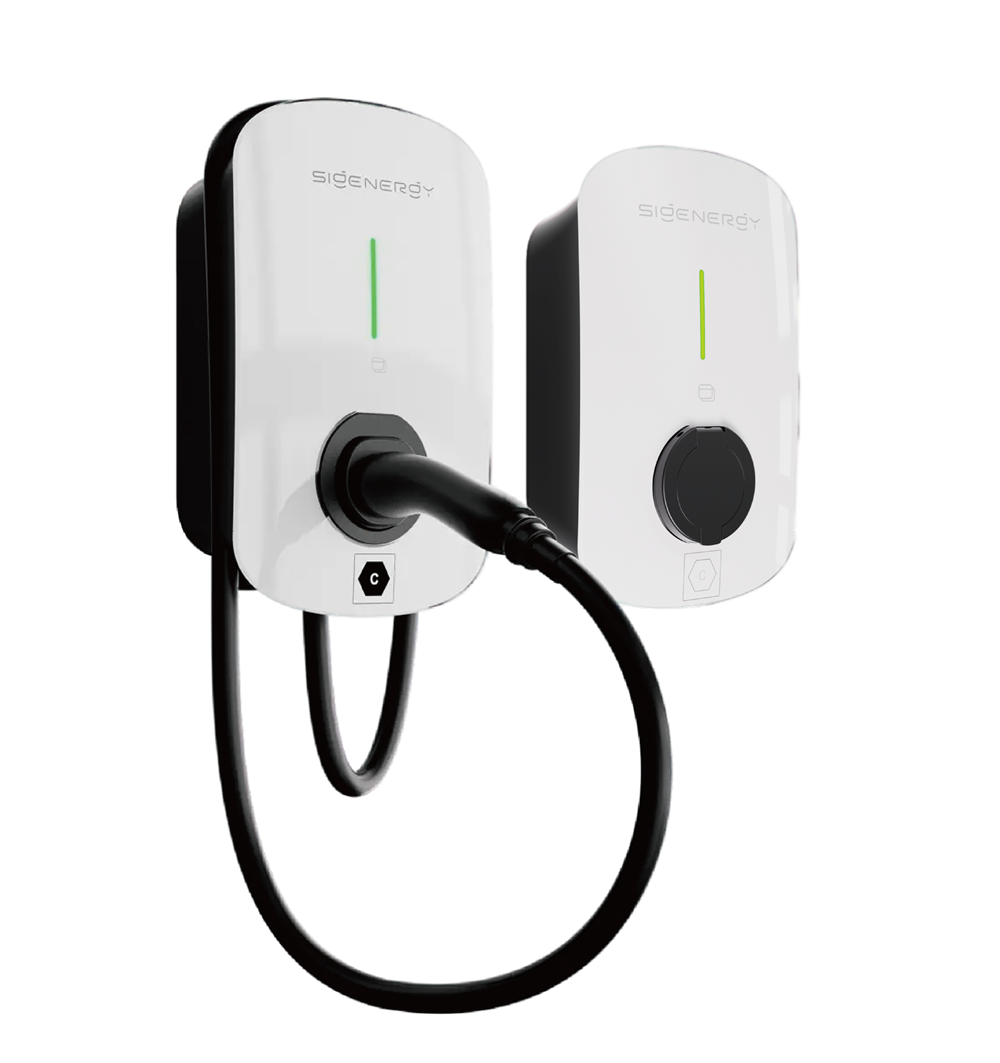
Popular Home EV Chargers in Australia
The charger itself is one decision, the electrical installation is another. Your electrician can install almost any brand — here are the units we're seeing most often on the Sunshine Coast:
Load Management and Solar — Why Smart Charging Matters
If you have solar panels on your roof (and a huge percentage of Sunshine Coast homes do), a smart charger is worth every cent of the price premium.
A standard EV charger draws at full rate regardless of what your solar is producing. A smart charger — like the Zappi, or any unit with solar integration — monitors your solar export in real time and adjusts its charge rate to match your excess generation. Instead of buying power from the grid at peak rates, you're consuming what would otherwise be fed back for a small export tariff.
On a typical Queensland day, a household with 6.6 kW of solar can generate enough excess between 9am and 3pm to add 50–80 km of range to a parked EV. Over a year, that's thousands of kilometres charged essentially for free.
The integration does require the charger to be wired into your system correctly and configured to communicate with your inverter or a CT clamp measuring your total consumption. That setup is part of what a qualified EV charging installer does — it's not a plug-and-play exercise.
Before We Quote: What We Check at Your Switchboard
This is a step many people overlook when budgeting for an EV charger. Before any work starts, we need to assess whether your switchboard can handle the additional load.
We look at:
- Main fuse/breaker rating — your home's supply limit (typically 63A or 100A for a suburban house)
- Current load — what your existing circuits are drawing, including air conditioning, hot water and pool equipment
- Available capacity — whether there's headroom to add a 32A EV circuit without overloading the supply
- Switchboard condition — older switchboards with ceramic fuses or no RCD protection need upgrading before we can add new circuits
- Metering setup — relevant if you're in a townhouse complex or have a shared supply
Most newer homes (built in the last 15 years) have switchboards with adequate capacity and RCD protection already in place. But if you're in an older property — say, a 1970s or 80s fibro home in Nambour or Caloundra — there's a real chance the switchboard needs attention first. We'll always tell you upfront if that's the case.
The Electrician vs the Charger Brand — Why This Distinction Matters
When you shop for an EV charger, you're shopping for a piece of hardware. When you hire Pip Electrics, you're engaging a licensed electrician to design and install the electrical infrastructure that makes that hardware work safely and efficiently.
The brand sells a box. We install the circuit, cable, protection devices, and commissioning — the stuff that determines whether the system is safe, up to code, and will hold up in Queensland's climate (humidity, heat, potential flooding in low-lying areas).
Charger brands will not cover warranty claims arising from improper installation. Energy Queensland will not be sympathetic if an improperly wired charger causes a fault. And your home insurer will want to know the work was done by a licensed sparky with a compliance certificate. Don't DIY this.
What Does It Cost?
Every installation is different, but the main cost variables are:
- Switchboard upgrades — if your board needs work, budget $800–$2,000 depending on scope
- Cable run length — a charger directly behind the switchboard is straightforward; a run to a detached garage 30 metres away is significantly more labour and materials
- The charger itself — basic units start around $500; smart solar-integrated units like the Zappi sit at $900–$1,200 before supply
- Conduit and accessories — surface mounting in a garage is simple; in-wall or underground trenching adds cost
As a rough guide, a straightforward Level 2 installation on the Sunshine Coast — switchboard with spare capacity, charger point in an attached garage — typically lands between $1,200 and $2,200 all-in including the charger unit. We provide a fixed-price quote after assessing your property, so there are no surprises.
Don't Have an EV Yet? Get Rough-In Ready
This is genuinely good advice and doesn't cost much to act on: if you're building, renovating, or even just doing other electrical work, ask us to rough in a dedicated 32A circuit and conduit stub-out to your garage now.
Running cable while walls are open, or while a trench is already dug for other services, costs a fraction of what it costs to do later. You get a future-proof circuit with a capped outlet — no charger yet, but the infrastructure is there waiting. When you buy an EV in two or three years, the wall unit goes in for a few hundred dollars rather than a full installation job.
It's cheap insurance for an appliance that's increasingly inevitable.
A Note on the Sunshine Coast Specifically
We work across the full Sunshine Coast hinterland and coast — Noosa, Peregian, Coolum, Maroochydore, Buderim, Kawana, Caloundra and everywhere in between. The coastal areas — Noosa Heads, Sunshine Beach, Mooloolaba — are already seeing strong EV adoption, and we're fielding more EV installation enquiries every month.
The Sunshine Coast's high solar penetration makes this region particularly well-suited to smart EV charging. If you've got panels on the roof and an EV in the driveway, the combination is hard to beat on running costs.
If you're thinking about it, give us a call. We'll come out, have a look at your setup, and give you a straight answer on what's involved and what it'll cost.